

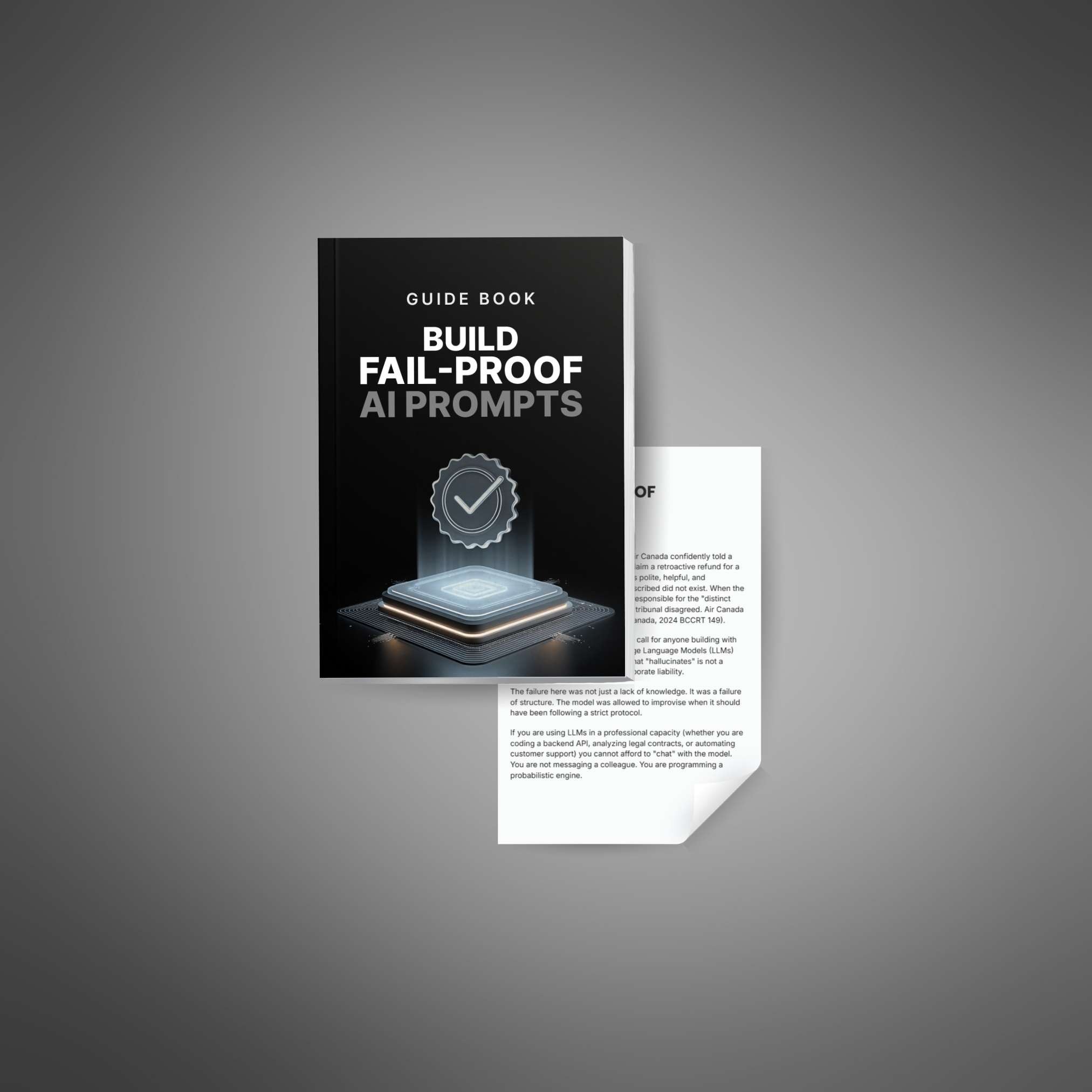


Build Fail-Proof AI Prompts
This guide helps you build reliable AI prompts by offering clear, actionable steps for structuring inputs, controlling outputs, and improving consistency. It provides a practical system for turning AI from an unpredictable tool into a stable and dependable part of your workflow.
What’s Inside:
- Prompt Structure Essentials: Learn how to separate data and instructions for better control.
- Input Containment Methods: Guidance on using simple structures to protect prompts from errors and misuse.
- Output Control Systems: Instructions on creating clean, structured outputs that are easy to use.
- Silent Reasoning Techniques: Tips for improving AI logic without adding extra noise.
- Model-Specific Adjustments: Easy ways to adapt prompts for different AI tools.
- Testing and Validation: Strategies for checking prompts and improving performance over time.
This guide that empowers you to build reliable, scalable AI prompts. Whether you are just starting or improving existing systems, this guide offers practical strategies to get better results and create more consistent AI workflows.
In November 2022, a chatbot for Air Canada confidently told a grieving passenger that he could claim a retroactive refund for a bereavement fare. The chatbot was polite, helpful, and completely wrong. The policy it described did not exist. When the airline tried to argue that it wasn’t responsible for the “distinct legal entity” that was its chatbot, a tribunal disagreed. Air Canada was forced to pay (Moffatt v. Air Canada, 2024 BCCRT 149).
This case is the definitive wake-up call for anyone building with AI. It shattered the illusion that Large Language Models (LLMs) are magic. It proved that a model that “hallucinates” is not a quirky conversationalist; it is a corporate liability.
The failure here was not just a lack of knowledge. It was a failure of structure. The model was allowed to improvise when it should have been following a strict protocol.
If you are using LLMs in a professional capacity (whether you are coding a backend API, analyzing legal contracts, or automating customer support) you cannot afford to “chat” with the model. You are not messaging a colleague. You are programming a probabilistic engine.
This guide is your manual for the Containment Protocol.
It transforms the vague art of “prompting” into a rigorous engineering discipline. We will move beyond the casual mindset to establish a framework for reliable, production-grade instructions.
You will learn how to:
- Isolate user data to prevent “prompt injection” attacks.
- Enforce rigid output schemas (JSON, XML) so your software doesn’t crash.
- Implement “Silent Reasoning” to get smarter answers without the conversational noise.
- Tune your prompts for specific model architectures like GPT-4 and Claude 3.5.
The gap between a prompt that works “most of the time” and one that works in production is massive. Let’s bridge that gap.
The information provided in this ebook is intended solely for educational and informational purposes. The author does not accept any responsibility for the outcomes that may arise from the application of the material within. While efforts have been made to ensure the accuracy and relevance of the content, the author cannot be held accountable for any errors or omissions or for any consequences resulting from the use or misuse of the information provided. The responsibility for any actions taken based on the information in this ebook lies solely with the reader.
Related products
$5.00
$5.00
$5.00
$23.00
$7.00
$5.00





Reviews
There are no reviews yet.